
APC and MPC
Advanced controls enable efficient operation of non-linear systems with strong couplings, operated across a wide range of conditions under strict constraints.
Information according to § 5 TMG (German Telemedia Act):
Dr. Rafał Noga
Im Kampfeld 10
29365 Sprakensehl
Germany
Contact
Phone: +49 175 617 6792
E-mail:
VAT ID (§ 27a UStG)
DE457893621
Academic title
Dr. (doctorate awarded in Spain)
Responsible for content according to § 55 Abs. 2 RStV: Dr. Rafał Noga (address as above).
This site uses no cookies, no external fonts and no tracking. The server keeps only technical logs (IP, timestamp, requested file) necessary to operate, purged regularly. If you contact me by e-mail or phone, your data will be processed only to answer your inquiry.
Data controller
Dr. Rafał Noga
Im Kampfeld 10, 29365 Sprakensehl, Germany
E-mail:
APC/MPC, state estimation, mathematical optimization and digital twins - from diagnostic to deployment, and beyond: long-term maintenance, tuning and knowledge transfer to keep performance high over time.

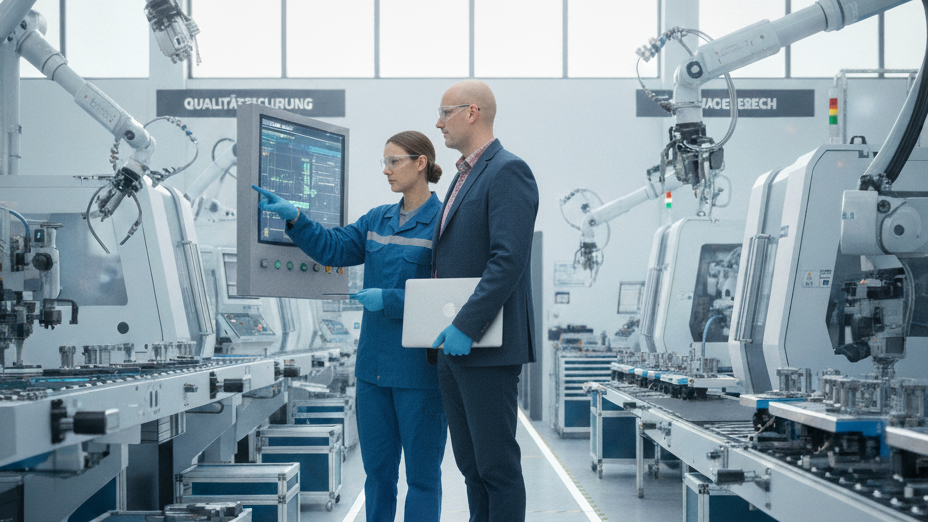
Bringing deep expertise and real-world results to industrial challenges.
Deep theoretical foundation plus many years of hands-on practice in R&D contexts, developing new types of systems where the solution is not obvious at the start. We adapt language to the audience and deliver key insights in a compact and engaging way.
Advanced controls enable efficient operation of non-linear systems with strong couplings, operated across a wide range of conditions under strict constraints.
Combine models with available sensors to improve accuracy, reduce the need for expensive sensors and estimate non-measurable variables.
Scheduling, logistics and resource allocation at plant level, and trajectory optimization for machines to increase throughput, reduce wear and lower energy costs.
Evaluate ideas and operating strategies without touching production. Parametric/sensitivity studies guide investment; models enable optimization and operator training.
Train operators offline to reduce interruptions and waste. Cover standard tasks, complex situations and safety-critical scenarios.
PhD-backed teaching and hundreds of public talks. Key knowledge delivered compactly and engagingly, tailored to experts, decision makers or technicians.
Cutting-edge, industry-standard tools chosen per application. Seamless integration with existing software and collaboration via version control.
Need something specific? Feel free to ask. We tailor solutions to your problem, process and industry.
Peer-reviewed papers, conference proceedings, and theses on Model Predictive Control, state estimation, and cryogenics at CERN.
arXiv:2403.00382
IECON 2018 - 44th Annual Conference of the IEEE Industrial Electronics Society
5th IFAC Conference on Nonlinear Model Predictive Control (NMPC), Seville. IFAC-PapersOnLine, 48(23), pp. 440-445
PhD Thesis, University of Valladolid
53rd IEEE Conference on Decision and Control (CDC), pp. 3530-3535
18th International Conference on Process Control, Tatranská Lomnica, Slovakia
18th IFAC World Congress, pp. 3647-3652
19th IEEE International Conference on Control Applications (CCA), Yokohama, Japan, pp. 1654-1659
Technical Report, CERN
MSc Thesis (Joint: Univ. Valladolid, ENSIEG Grenoble, Univ. Karlsruhe, Politechnika Gdańska)
Published references showing how APC/MPC technology delivers measurable results across industries.
How embedded MPC delivers deterministic constraint-respecting control within hard timing budgets on microcontrollers, DSPs, and onboard computers.
Read more →Economic MPC replaces tracking setpoints with direct cost optimization, delivering 17%+ energy savings in buildings and enabling coal-free cement operation.
Read more →MPC-based navigation for autonomous vehicles and mobile robots: perception-planning-control pipelines validated from racing to industrial AGVs.
Read more →MPC formulations that manage physical contact forces for safe human-robot interaction, reducing collision forces by up to 77% while maintaining task performance.
Read more →How GP-MPC, neural MPC, and adaptive control augment model predictive control to handle model mismatch, yielding up to 82% error reduction in real systems.
Read more →How nonlinear MPC and APC improve energy efficiency, product quality, and throughput across steel, cement, pharma, chemicals, and building HVAC processes.
Read more →Constraints-first MPC/NMPC for legged robots achieving 100+ Hz control with friction cones, torque limits, and variable step timing as core optimization variables.
Read more →MPC formulations that maintain collision-free motion while handling uncertainty in localization, perception, and obstacle predictions.
Read more →Model Predictive Contouring Control optimizes path progress vs. tracking accuracy for robots, CNC, AGVs, and autonomous vehicles.
Read more →Model Predictive Control applied to electric drives and power electronics: torque ripple reduction, fault ride-through, and active magnetic bearing control.
Read more →How co-designing state estimation (EKF, MHE, sensor fusion) with MPC/NMPC enables deployable control for cranes, robots, servos, and manipulators.
Read more →Two-stage pattern: offline trajectory optimization generates optimal references that online MPC tracks in real time, proven in wind energy, batch chemicals, and drone racing.
Read more →MPC for robotic arms delivers 70% lower tracking deviation in milling, 65% contour error reduction, and tactile-reactive grasping at 25 Hz via constraint-aware control.
Read more →MPC for autonomous underwater vehicles: handling thruster saturation, depth-pitch coupling, and safety constraints validated in lake and sea trials.
Read more →NMPC for aerial vehicles enabling aggressive maneuvers, 82% tracking error reduction, time-optimal racing, and 57% faster swarm missions vs reactive baselines.
Read more →See how much you could save with Advanced Process Control. Enter your approximate annual costs below.
Estimates based on typical industry results. Actual savings may vary.
Focused on practical results for manufacturing, machine builders, process industry and energy generation.
Guide operators or auto-adapt parameters when conditions change to reduce waste and raise throughput, by smart sensing and modeling relationships between desired parameters and environmental conditions.
Optimize the way your machine operates, increase precision through perfect feedback loops and trajectory optimization; make it more resilient to perturbations, reduce component wear and lower energy requirements.
Optimize mixing and processing, handle changing inputs, meet output quality and demand. Balance throughput, quality, energy and waste via advanced process control involving model-based predictive control and state estimation.
Increase energy yield while reducing component wear by damping oscillations through smart feedback loops and using model-based predictive control to optimize operation.
Book a free 30-minute consultation to discuss your challenges.
Clarify data, goals & constraints; identify quick wins.
Digital twins, first MPC/estimators; prove potential.
Proof-of-concept on process/machine, tune parameters.
Industry-grade implementation, training, tuning & support.
Agile in 2-week sprints – with clear, usable deliverables after each sprint.
Four engagement types with clear scope, high-quality execution and professional standards. Remote or on-site.

Uncover bottlenecks and opportunities using data analysis, on-site observations and feedback from your team. From insights to business cases and a practical roadmap.

20 years across the full lifecycle: requirements, architecture, implementation, testing, deployment and documentation on PCs, industrial systems, SCADA and embedded.

Hundreds of talks in five languages. Operator training with digital twins; engineer training in advanced control, state estimation, optimization; team mentoring.

Provide the technical expertise to assess and hire the right people, leveraging a broad network to find strong candidates.
Custom solutions where it matters, and standard tools where they fit best.
Short reaction times and pragmatic delivery to keep momentum.
Maintenance, tuning, support and knowledge transfer to sustain performance.
Data analysis plus workshops with operators and management to uncover real problems.
Use simulation and optimization to save experimental time and reduce risk during development and commissioning.
Carefully weigh risks and benefits; enable progress via controlled trials of new parameters and approaches.
Two-week sprints with usable results each time; quick adaptation to changing requirements and experimental findings.
Strong foundations in mathematics, physics, computer science, control systems and optimization - applied to real problems.
Agile execution in two-week sprints across all packages, including clear deliverables after each sprint.
Understand the problem, data and objectives; identify quick wins and a sensible path forward.
Deliverables: analysis report + concise technical proposal.
Get startedRecreate the setup in simulation, build first models/estimators, run realistic studies to assess potential.
Deliverables: simulation study report + draft plan for experimental proof of concept.
Learn moreBring simulation into reality, run controlled tests, adapt parameters and validate performance on site.
Deliverables: test plan + on-site report + tuned settings.
Learn moreEngineering aides or operator-training tools based on models; designed for non-experts.
Deliverables: working prototype + brief user guide.
VFD Pump Tuning Tool →
Free online tool for tuning VFD-driven water pumps.
Harden to industrial standards with documentation, safety and quality gates - ready for scale.
Deliverables: codebase and docs aligned with agreed standards.
Deploy on the machine or process. Operator training, extensive testing and final documentation.
Deliverables: commissioning report, training materials, SOPs.
Maintenance, tuning, adaptations and knowledge transfer - ongoing or punctual.
Deliverables: per-sprint updates and improvement notes.
Defined jointly upon agreement to match your specific needs and constraints.
Deliverables: as agreed, per-sprint outcomes and documentation.
Below you will find typical cooperation models as they are practical in the technical SME sector (engineering/development/plant environment). The daily rates shown are starting prices ("from") net plus VAT and will be specified in the offer based on the specific project context.
Regardless of the billing model, development is agile:
Suitable for: Clearly defined deliverables with defined acceptance (e.g., analysis package, model audit, MPC concept, prototype, optimization module).
Billing: Fixed price per milestone/package; acceptance based on clear criteria.
Suitable for: Plannable capacity, regular reviews, quick support ("keep-the-lights-on" + minor enhancements).
Billing: Monthly contingent (e.g., X days/month), optionally with defined response times.
Purpose: Quickly clarify scope, make risks/dependencies visible.
Result: KPI target picture, system boundaries, data/interface list, integration plan, effort estimate, and offer model (T&M or milestones).
Purpose: Quick external start, then internal anchoring.
Service: Setup, stabilization, knowledge transfer, optionally recruiting support (role profile, interview support) and structured onboarding of internal owner.
An internal FTE with a €100,000 gross salary costs the company (roughly calculated) about ~€720 per productive day.
→ Internal full cost per productive day: 144,000 / 200 = ~€720/day
The specific conditions typically depend on:
Depending on the project, cooperation can also be structured as Solution-on-Demand:
It can be agreed that we will not sell or license the developed solution to direct competitors of the customer (e.g., as industry/competitor exclusivity for a defined period and/or market), with scope and limits to be precisely defined contractually.
The models above are proven standards — individual structures are also possible. Whether daily rate, milestones, retainer, license model, or exclusivity: We design the cooperation to fit scope, risk, budget, and your procurement/compliance process.
The cooperation possibilities are practically unlimited – we will find a clean, fair way.
Note: This page is for general information and does not constitute legal advice. The specific terms are bindingly regulated in the respective offer and contract.
Schedule a 30-minute call to discuss your process challenges and explore potential solutions.
Answer 5 quick questions to evaluate if your process is ready for Advanced Process Control.
Your process shows strong potential for Advanced Process Control.
Short and clear: practical notes on control, optimization and digitalization.
Common questions about Advanced Process Control and working together.
MPC is an advanced control strategy that uses a mathematical model of your process to predict future behavior and optimize control actions. It excels at handling multi-variable systems with constraints, delivering better performance than traditional PID control.
Timelines vary by scope. A diagnostic phase typically takes 2-4 weeks. A full proof-of-concept can be completed in 2-3 months. We work in agile 2-week sprints with deliverables at each stage.
Typical results include 5-15% energy savings, 10-30% throughput increase, and significant waste reduction. ROI is often achieved within 6-12 months depending on the application.
Both. Many phases can be done remotely, including data analysis, model development, and simulation. On-site presence is valuable for commissioning, operator training, and initial diagnosis.
Process industry (chemicals, pharma, food & beverage), manufacturing, machine builders, and energy generation. Any industry with complex, multi-variable processes can benefit.
Have more questions?
Ask directlyAssess if your process is ready for Advanced Process Control. A practical guide with 15 key questions.
Learn how Advanced Process Control can transform your operations
Dr. Rafał Noga
Germany
Verified Credentials
Verifiable excerpts from work certificates and recommendation letters — documenting hands-on experience in optimization, model predictive control, and state estimation.
Note: Company names are for context on previous positions and do not represent client endorsements.
Documented Tasks (verbatim excerpts)
Performance Rating (very good)